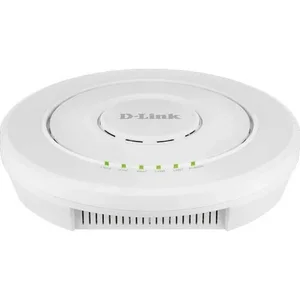
General InformationWave 2 - the new wireless standardAs more and more mobile devices connect to wireless signals, and as the Internet of Things trend comes on song, there has never been a more crucial time for the 802.11ac Wi-Fi standard to move on. Addressing this need for additional wireless bandwidth is 802.11ac Wave 2, which is highly likely to become the most popular Wi-Fi standard ever. Among it's many benefits are: Incredible speed The relatively fast 802.11ac (on 5 GHz) offers a theoretical max data throughput rate of 1.3 gigabits per second. Wave 2 can potentially offer up to 6.8 Gbps in the future.Ideal for on-the-move employees A Wave 2-enabled hot spot will intelligently determine what kinds of devices are pinging it, and whether they're stationary or mobile. The MU-MIMO sounding rate control within Wave 2 ensures that the data rate given to hardware on the move is adjusted as necessary, allowing people to use their preferred mobile device no matter where they are. Single-antenna mobile devices gain all the benefits While 802.11ac is much faster than previous standards like 802.11n, its impact was limited since the connecting device needed multiple antennas. Wave 2 addresses this issue by consolidating multiple data streams at the source. Better able to scale 802.11ac Wave 2 and MU-MIMO will help Wi-Fi networks scale to increase capacity, even when predominantly single-antenna devices are in use, which increases network performance without additional cost or power demands. More intelligent network processing In addition to being able to adjust throughput for devices on the go, a Wave 2 hot spot will also intelligently adjust bandwidth based on past and present conditions. There is a lot more built-in intelligence within Wave 2 versus past wireless iterations, allowing the network to adjust itself as necessary to meet demands. Avoids congestion Devices such as Bluetooth headsets (and even microwaves) operate on the 2.4 GHz band, making it one of the most popular (crowded) radio frequencies in use today. But that means interference which will affect performance. Wave 2 operates on the 5 GHz band which is far less congested.Backwards compatibility A Wave 2-enabled hot spot will be backwards compatible with the original 802.11ac standard, thus ensuring that all hardware will benefit from this upgrade, even if it was built specifically with 802.11ac or even 802.11n in mind.Technical InformationWireless LAN Standard: IEEE 802.11acFrequency Band: 5 GHzWireless Transmission Speed: 2.15 Gbit/sMIMO Technology: Yes
Technical Specifications
General Wireless Interface IEEE 802.11b/g/n 2.4 GHz wireless IEEE 802.11/a/n/ac Wave 2 5 GHz wireless MIMO 2 x 2 Data Rate 2.4 GHz - Up to 400 Mbps 5 GHz (1) - Up to 867 Mbps 5 GHz (2) - Up to 867 Mbps Antenna Internal omnidirectional antennas 2.4 GHz: 3 dBi 5 GHz: 4 dBi Operating Frequency 2400 to 2483.5 MHz 5150 to 5850 MHz Operating Channels 1 to 13 channels for 2.4 GHz band (per country code) 36 to 165 channels for 5 GHz band (per country code) Ethernet Interface 2 x 10/100/1000BASE-T LAN port Console Port RJ-45 Functionality Advanced Features Auto Channel selection 802.1p Quality of Service (QoS) Wireless Multimedia (WMM) Wireless Distribution System (WDS) Band steering Airtime Fairness Link Aggregation IEEE 802.11k Fast Roaming Management Operating Mode Standalone mode Managed mode - Centrally managed by D-Link Wireless Controller Management Interfaces Web-based User Interface (Web UI) Telnet/SSH Command Line Interface (CLI) SNMP v1/v2c/v3 Security SSID Security Up to 32 SSIDs, 16 per radio 802.1Q VLAN Station Isolation Wireless Security WPA/WPA2 Personal/ Enterprise AES TKIP Detection and Prevention Rogue and Valid AP Classification Authentication MAC Address Filtering Physical Power Supply External power adapter: 12 V DC 2.5 A (not included) Supports 802.3at PoE PD on LAN 1 Port Power over Ethernet IEEE 802.3at Maximum Power Consumption 20 W Enclosure Bottom cover - plastic Top cover - plastic UL2043-certified chassis Temperature Operating: 0 to 40 oC (32 to 104 oF) Storage: -20 to 65 oC (-4 to 149 oF) Humidity Operating: 10% to 90% non-condensing Storage: 5% to 95% non-condensing MTBF 753,019 hours Certifications CE, FCC, IC, cUL+UL, CB, RCM, NCC, BSMI, UL2043 EN55032, EN55024, EN61000-3-2, EN61000-3-3, EN60601-1-2 (Medical electrical equipment), EN301489-1, EN301489-17, EN300328, EN301893 Item Dimension (L"xW"xH") 12 x 12 x 4