29+Years
29+Years
29+Years
1 Available
Condition: New

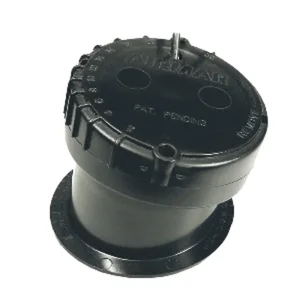
P79 NMEA 2000 In-Hull 235 kHz
The P79 in-hull transducer easily adjusts to hull deadrise angles up to 22 °. This ensures that the beam is vertically oriented to receive echos, resulting in accurate depth readings. Unlike traditional "puck" type transducers, our P79 consists of a base that is bonded to the hull and filled with liquid. The separate transducer then attaches to the base with a twist lock. The sound waves travel more efficiently though the liquid, giving the best possible performance.
The unique adjustable-angle design ensures the beam is vertically oriented for maximum echo returns and the best possible performance. Because the transducer is mounted inside the hull, it is the perfect solution for rigid inflatable boats (RIBS) and racing sailboats.
Features:
The Airmar P79 NMEA 2000 In-Hull 235 kHz transducer is designed for marine depth measurement without requiring hull penetration. This unit is suitable for IT and marine professionals managing vessel instrumentation, particularly for rigid inflatable boats (RIBS), racing sailboats, and planing-hull power boats. Its in-hull mounting eliminates the need for drilling, preserving hull integrity and reducing drag. The P79-235-N2 features an adjustable-angle design, accommodating hull deadrise angles up to 22 degrees to ensure the transducer beam is vertically oriented for accurate depth readings. The system utilizes a liquid-filled base bonded to the hull, through which sound waves travel efficiently for optimal performance. This transducer provides depth-only data at a frequency of 235 kHz with an 11-degree cone angle. It is recommended for solid fiberglass hulls and can be epoxied to aluminum hulls under 0.38 mm (0.150�) thick.
P79 NMEA 2000 In-Hull 235 kHz
The P79 in-hull transducer easily adjusts to hull deadrise angles up to 22 °. This ensures that the beam is vertically oriented to receive echos, resulting in accurate depth readings. Unlike traditional puck type transducers, our P79 consists of a base that is bonded to the hull and filled with liquid. The separate transducer then attaches to the base with a twist lock. The sound waves travel more efficiently though the liquid, giving the best possible performance.
The unique adjustable-angle design ensures the beam is vertically oriented for maximum echo returns and the best possible performance. Because the transducer is mounted inside the hull, it is the perfect solution for rigid inflatable boats (RIBS) and racing sailboats.
Features:


The product includes the P79 in-hull transducer and a 6-meter (20-foot) NMEA 2000 cable with a connector.
The primary benefit is that it requires no holes to be drilled in the hull, preserving hull integrity and eliminating hull protrusions. This makes it ideal for rigid inflatable boats (RIBS), racing sailboats, and trailered boats.
The Airmar P79 transducer can adjust to hull deadrise angles up to 22 degrees. This ensures the beam is vertically oriented for accurate depth readings.
P79-235-N2 - Airmar P79 NMEA 2000 In-Hull 235 kHz