29+Years
29+Years
29+Years
2 Available
Condition: New

Use of multiple battery banks dictates that the batteries be connected or "integrated" only whenever a charge voltage is present so that they may be charged simultaneously, then disconnected or "isolated" when in use to allow for selective discharge and avoid having the secondary or standby battery drain into the primary battery.
The new Battery Integrator performs this function automatically, acting as a "smart" switch to connect independent battery banks only when a charging voltage is present. Otherwise, they are isolated, and discharge between banks is prevented.
The traditional rugged and reliable diode isolator can also be used for this function, as it also maintains isolation between banks and allows charging from multiple sources. However, one drawback is inefficiency when voltage is lost as current passes through the diodes, resulting in undercharge if the charging source does not compensate for the voltage drop.
The Battery Integrator remedies this by use of an extremely low resistance contactor which causes no voltage drop in the charging system, while the multiple batteries are charged as a single bank whenever a charging source of approximately 13.2 VDC or 26.4 VDC or greater is present (depending on model).
When the alternator or charger is off or a large load causes the voltage to drop below the disconnect point the unit breaks the common tie between the banks. This allows selective battery discharge and prevents "dumping" of a higher-charged bank into a lower-charged bank.
The unit may also be activated through the key starter or a manual switch to provide an added "boost" from the secondary battery whenever the starter is engaged and the unit senses there is sufficient voltage in that battery to provide an assist.
For systems with more than two banks, an additional unit may be installed for each additional bank to provide the same isolation and integration as described above.
The Battery Integrator is ideal for multiplying the single charging output of an inverter-charger to maintain both the house bank and an engine start bank, then to isolate them during inverter function, so current is drawn from the house bank only.
Features
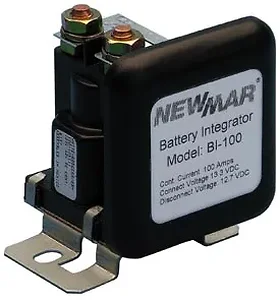
The Newmar BI-100 12v Battery Integrator, part number 490-4345-0, is designed for managing multiple battery banks in IT hardware systems. This device functions as a 'smart' switch, automatically connecting independent battery banks for simultaneous charging when a charge voltage of approximately 13.2 VDC or 26.4 VDC or greater is detected. When the charging source is off or voltage drops, the unit isolates the banks, preventing discharge between them and allowing for selective battery use. This addresses the inefficiency of traditional diode isolators by using a low-resistance contactor, which eliminates voltage drop during charging. It is suitable for environments requiring efficient power management across multiple battery sources, such as those utilizing inverter-chargers to maintain both primary and secondary battery banks. The BI-100 ensures that current is drawn only from the designated bank during operation, while enabling a 'boost' function from a secondary battery when the starter is engaged, provided sufficient voltage is available.
The Newmar BI-100 features a heavy-duty silver-plated contactor that is continuously rated for 100 amps.
The Battery Integrator utilizes an extremely low resistance contactor, which causes no voltage drop in the charging system, allowing multiple batteries to be charged as a single bank.
Yes, for systems with more than two battery banks, an additional unit may be installed for each additional bank to provide the same isolation and integration.
The Battery Integrator is ideal for multiplying the single charging output of an inverter-charger to maintain both a house bank and an engine start bank, then isolating them during inverter function so current is drawn from the house bank only.
490-4345-0 - Newmar Power Newmar BI-100 12v Battery Integrator