29+Years
29+Years
29+Years


94 Available
Condition: New

HISTORY ASPECTS:
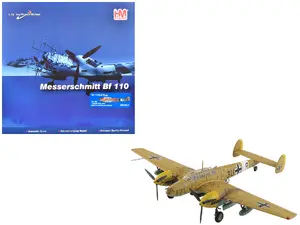
The Messerschmitt Bf 110E-2, marked 3U+AR of 7. Staffel, Zerstörergeschwader 26 (ZG 26), was deployed to Italy in 1941 during the height of the Mediterranean campaign. Originally designed as a long-range heavy fighter, the Bf 110E series benefited from improved armor, bomb racks, and reinforced airframes, making it more suitable for the demanding roles it would encounter in the southern theater. Stationed in Italy, aircraft like 3U+AR provided bomber escort for raids against Malta and Allied shipping lanes, as well as ground-attack missions over North Africa. The aircraft’s range and versatility made it valuable in an environment where the Luftwaffe needed to project power across vast expanses of sea and desert.
During 1941, Bf 110E-2s flew extensively in support of Axis forces in North Africa, often launching from Sicilian and southern Italian airfields to strike British convoys resupplying Malta or reinforcing the Eighth Army in Egypt. Aircraft like 3U+AR faced increasingly dangerous opposition from RAF Hurricanes and Spitfires based on Malta, as well as long-range Bristol Beaufighters tasked with hunting Axis aircraft. Although the Bf 110’s speed and firepower made it formidable in boom-and-zoom attacks, its lack of agility left it vulnerable in prolonged dogfights. This resulted in high losses, yet the aircraft remained in frontline service due to its ability to carry bombs, rockets, and to serve as a fighter-bomber—roles that single-engine fighters of the time struggled to balance.
The 7. Staffel of ZG 26, known as the “Horst Wessel” Geschwader, gained a reputation for resilience despite operating under difficult conditions. Bf 110 crews flew long missions over the Mediterranean, often battling both the enemy and mechanical strain from heat and dust in desert conditions. Specially weathered aircraft such as 3U+AR bore the visible scars of this harsh service environment—sun-faded camouflage, chipped paint, and sand erosion that reflected the relentless operations of 1941. These weather-worn machines became symbols of the Luftwaffe’s struggle to maintain air superiority in a theater where Allied strength was steadily growing.
This 1:72 scale model captures the unique weathered finish that tells the story of its service in the Mediterranean skies of 1941. With meticulous attention to detail in camouflage and markings, it provides collectors and historians with a striking representation of one of the Luftwaffe’s most iconic heavy fighters, making it an essential addition to any World War II aircraft collection.
The Hobby Master HA1817 Messerschmitt BF 110E-2 Trop Fighter Aircraft is a 1/72 scale diecast model, representing a specific German Luftwaffe aircraft, "3U+AR 7./ZG26 Italy," as it appeared in 1941. This model is part of Hobby Master's "Air Power Series." It is designed for businesses or IT departments involved in historical archiving, museum displays, educational programs focusing on military aviation history, or corporate collections. The HA1817 provides a detailed, pre-assembled representation of a significant World War II aircraft, suitable for display purposes without requiring assembly or painting. It addresses the need for accurate, ready-to-present historical aviation artifacts in a professional setting.


This Hobby Master model is produced in 1/72 scale, offering a detailed representation of the original aircraft in a reduced size.
The model depicts a Messerschmitt BF 110E-2 Trop Fighter Aircraft with the markings "3U+AR 7./ZG26 Italy" from the German Luftwaffe, as it appeared in 1941.
No, this is a diecast model, meaning it comes pre-assembled and pre-finished, ready for display right out of the box.
This Messerschmitt BF 110E-2 Trop Fighter Aircraft model is part of Hobby Master's "Air Power Series".
HA1817 - Hobby Master Messerschmitt BF 110E-2 Trop Fighter Aircraft "3U+AR 7./ZG26 Italy" (1941) German Luftwaffe "Air P