29+Years
29+Years
29+Years


59 Available
Condition: New

HISTORY ASPECTS:
Supermarine Spitfire PV202 rolled off the Castle Bromwich production line as a single-seat Mk IX fighter in the summer of 1944. Accepted by the RAF in August, it joined 33, 412, and later 401 Squadron, flying armed reconnaissance and close-support sorties across northwest Europe after the Normandy landings. In these closing months of the war PV202 escorted tactical bombers, strafed rail targets, and helped keep pressure on retreating German formations. Post-VE Day, it served briefly with the Royal Netherlands Air Force before returning to Britain and, like many surviving fighters, was placed in storage.
During the 1950s the airframe was sold to the Irish Air Corps, which converted a batch of surplus Mk IXs into two-seat trainers—designated T9—so that new pilots could master the delicate handling of a high-performance, prop-driven fighter in a safer dual-control cockpit. PV202 logged nearly two decades in Irish service before retirement in 1960, after which it passed through several civilian owners and endured a period of dormancy. A comprehensive restoration beginning in the 1980s returned the aircraft to airworthy condition, retaining its trainer layout while painstakingly refitting wartime systems and detailing.
Today PV202 flies from Duxford Airfield under the stewardship of Aerial Collective, wearing the markings of Spitfire Mk IX ML365 “JW” of 135 Wing, 2nd Tactical Air Force. The scheme honours the Wing’s ground-attack operations in early 1945, when its Spitfires provided low-level cover for Allied armour racing toward the Rhine. Though PV202 itself never wore these codes in combat, the livery links visitors to the Wing’s relentless sorties against bridges, locomotives, and troop columns that hastened Germany’s collapse. At Duxford, PV202 now offers passenger flights, allowing enthusiasts to experience the sound and sensation of a Merlin engine above the Cambridgeshire countryside.
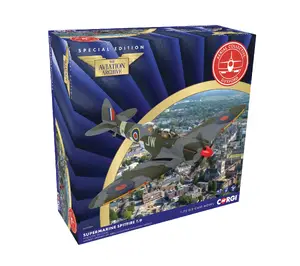
Rendered in superb detail, this 1:72 model captures the elegance of the two-seat Spitfire and its post-war trainer canopy while evoking the combat heritage of 135 Wing. An ideal centrepiece for any WWII or warbird collection, it celebrates the machine’s extraordinary journey from frontline fighter to flying classroom to living memorial in the skies over Duxford.
The Corgi Supermarine Spitfire T.9 Aircraft "PV202 Aerial Collective at Duxford Airfield" is a 1/72 scale diecast model, part of "The Aviation Archive" Series. This model replicates a British Royal Air Force Supermarine Spitfire T.9, specifically PV202, as operated by Aerial Collective at Duxford Airfield. It is designed for businesses or individuals involved in aviation history, museum displays, educational exhibits, or corporate collections that require accurate, scaled representations of iconic aircraft. The model provides a tangible, detailed replica without requiring assembly, suitable for immediate display. Its primary function is to serve as a high-fidelity static display piece, offering a precise visual reference of the aircraft. The part number for this specific model is AA29204.


This Corgi model is produced in a 1/72 scale, accurately representing the dimensions of the Supermarine Spitfire T.9 aircraft proportionally.
This diecast model represents the Supermarine Spitfire T.9 aircraft, specifically the "PV202 Aerial Collective at Duxford Airfield" variant, from the British Royal Air Force.
No, this is a diecast model, meaning it is pre-assembled and ready for display directly out of the packaging.
This model is part of Corgi's "The Aviation Archive" Series, known for its detailed replicas of historical aircraft.
AA29204 - Corgi Supermarine Spitfire T.9 Aircraft "PV202 Aerial Collective at Duxford Airfield" British Royal Air Force